

There’s a lot of advice out there about how to build new habits — some of it good, some of it terrible — and here in this blog post, we’re going to break down what ACTUALLY works to build positive, new habits. First, we'll begin with some of the bad advice that will steer you in the wrong direction:
BAD ADVICE YOU'LL COMMONLY HEAR ABOUT HOW TO BUILD HABITS:
Bad Advice #1: "Just do a pathetically small amount each day!" (e.g., do just 1 pushup)
This is something you'll hear a lot, and it's frankly one of the pieces of advice that I hate most in this field. BJ Fogg, in his book Tiny Habits, is probably the most notable advocate of this method.
The advice goes something like this: "Look, we all know it's a real tough grind to do a full workout, right? Well, here's how you build the workout habit: Just set the goal to do ONE PUSHUP each day! And whammo, just like that, you've built the workout habit, AND before you know it you'll be doing 2, 3, or even 4 pushups!"
Here is my take on this piece of advice: If you can't discipline yourself to do a proper workout, you are absolutely fucked in life, simple as that. More broadly speaking, if you can't exercise the self-discipline required to decide what's good for you, decide what actions/habits would help you to achieve your goals, and then just do the daily actions required to turn those goals into a reality, I don't think that you have ANY realistic chance of achieving that goal.
There are SOME limited scenarios where this advice may work. For example, "just floss one tooth!" is something BJ Fogg recommended for building the flossing habit in his book. In very narrow, specific cases, where it truly is just a matter of getting into motion, and building that initial momentum that will carry you through the rest of the task, ok yes in THOSE scenarios I think this piece of advice can actually work. Oftentimes it really is just a matter of breaking through the inertia, and sometimes just mechanically beginning the actions is enough to carry you through to the completion of the habit. But for big, meaningful, brutally difficult habits and activities, this piece of advice is a guaranteed recipe for a life of absolute mediocrity. For the stuff in life that's really, truly hard — and that requires hour after hour of concentrated effort — "just write one line of code" or "just work on building your business for one measly minute" is simply not going to cut it.
Bad Advice #2: "Just reach 21 days and you're good / then it gets easy"
There's all sorts of different "magic numbers" that get tossed around for habit formation: "Just do the thing for 21 days, 30 days, or 90 days, and you're GOLDEN, baby!"
Here's the harsh reality that will be a cold slap in the face to many people: On day 31 of your habit journey, what you'll unfortunately probably realize is that it still sucks balls to do this thing. On day 45, it's probably still going to be a difficult grind. Day 91 rolls around, surely by NOW it will be a blissful cakewalk of intrinsic enjoyment to do the thing, right? Nope, in reality, it's probably ALWAYS going to suck and it's probably ALWAYS going to require willpower and discipline to FORCE YOURSELF to get the job done.
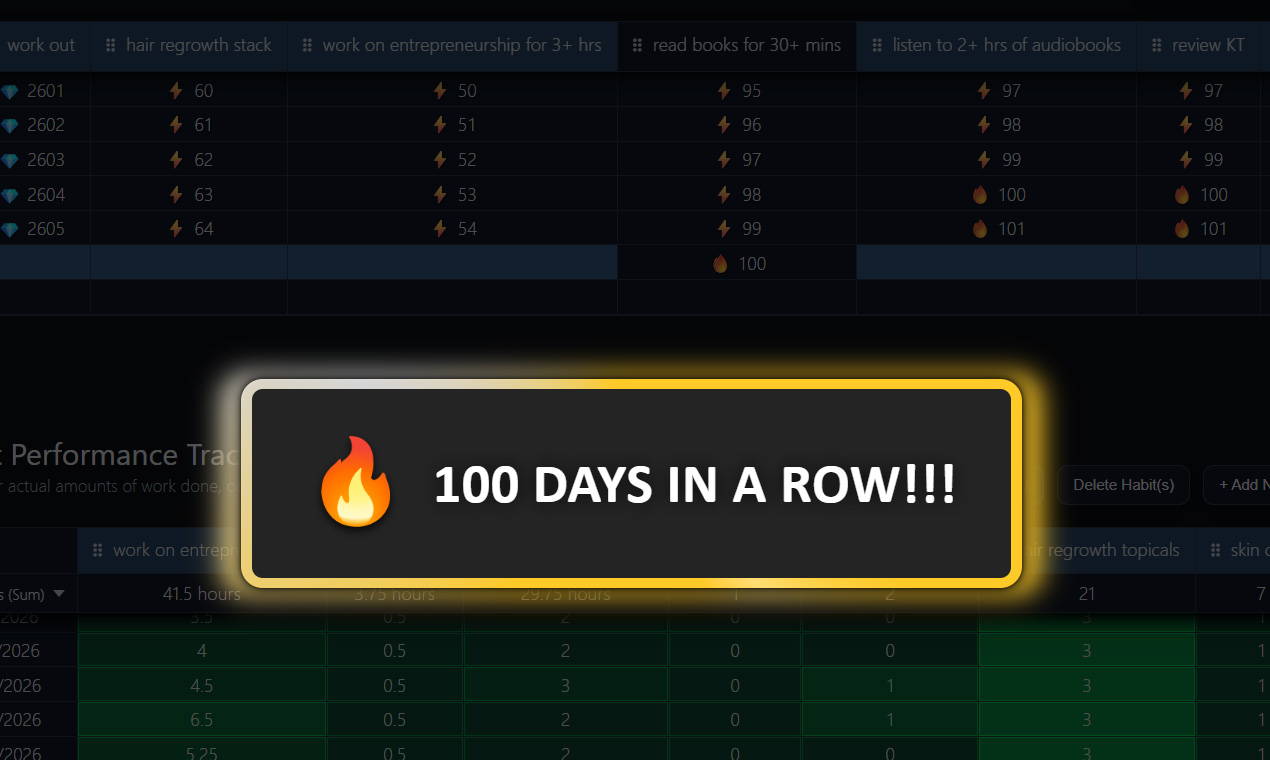
I've had many habits that I've done for far longer than these magic numbers. When I was much more aggressive about reading physical books, I had a "read for 2+ hrs per day" streak that was over 500 days long. I have a currently-active workout streak that's been going strong for over 2600 consecutive days. The point is not about how great I am (I mean, yes, that's PART of the point...), the point is that no matter how many days in a row I have executed on a given habit, in almost all cases, it never gets easier, it never becomes an intrinsically enjoyable experience of pure bliss, and it almost always requires just a disciplined effort to force myself to do this difficult thing that I've decided is good for me.
There's definitely a lot to this idea of ratcheting in more and more days in a row that you've executed on a habit, however where this piece of advice commonly goes wrong is in framing it like: "After you hit the magical number, THEN it becomes not just easy, but you really start to enjoy it!" In my actual experience of getting a lot of shit done, this happy day of frolicking in the sun almost never arrives. This doesn't mean every single moment of doing the work is always just this punishing slog where your life is pure agony; indeed, oftentimes you DO have moments or sessions of doing something difficult that's enjoyable.
But the key point is this: If you're expecting it to get easier after 28 days, I would argue that you're setting yourself up not just for disappointment, but you could be positioning yourself for outright failure where you quit on your good habits once you finally realize that it is NEVER going to get easier. By contrast, if you go into it EXPECTING it to be difficult, that paradoxically makes it easier to do the work each day, because at least now you know what you're getting into and you're not fooling yourself about how you should be feeling versus how you actually are feeling. As Brian Tracy so perfectly put it: "Of course it's time consuming, and hard work — that's why failures don't do it!"
GOOD ADVICE THAT ACTUALLY WORKS FOR BUILDING NEW HABITS
Good Advice #1: Simply schedule it in. Pick a clear start time, an end time, and work for that duration.
This is one of those time-management / productivity ideas that I keep re-discovering over the years. No matter how many clever techniques, systems, or tricks I try to come up with, I eventually find myself re-realizing (like it's some grand breakthrough) that: "Yep, just about nothing works as effectively as deciding what I would like to get done, then allocating a clear block of time for it, and forcing myself to work on that task for the specified duration."
It's beautifully simple, and it's beautifully effective.
Good Advice #2: First, eliminate the bad habits that are standing in the way of your desired good habits.
Again, sounds incredibly simple and obvious. Ok, well, are you doing this? Or are you wasting your time on bullshit and distraction each day?
There's probably some wise, Confucius-like quote I could dig up here on this to make me sound REALLY intelligent: "To make way for the new, the old must be swept away like a swift brush fire", or something like that. I did actually see some random influencer (random to me at least, apparently her name is Bianca Menard) drop a super deep quote on this while I was doomscrolling one day: "The only reason you're not living the life you want to live is because you keep feeding the life you DON'T want to live."
Powerful shit from, whoever that lady is. Bottom line is: There's a lot of things you could and would like to be doing, if only you weren't wasting so much time on undesirable bullshit each day. Many of us make excuses about how little time we have, how we're so busy, but if you actually count up the sum total of minutes wasted on pure distraction each day by the average person, the cumulative amounts are staggering. Stop kidding yourself about how productive you actually are, take an honest assessment of all the time you're wasting each week, and ask yourself what you could get rid of so you could make room for these new, positive habits you'd like to implement in your life.
One more quote to help illustrate this concept: Brian Tracy often talks about the Law of Substitution, as it relates to improving your thinking. As he puts it, "The mind can only hold one thought at a time. You cannot simultaneously think a positive and negative thought." His explanation of this concept is more related to becoming a positive thinker, by crowding out the negative thoughts and replacing them with positive thoughts to supplant them. The same concept applies to time-management and habit-formation: You can EITHER be spending your time on a positive habit, or a negative habit. And if you eliminate all the negative, destructive habits in your life, what inevitably must take their place are positive, beneficial habits.
Good Advice #3: Build "consecutive days in a row" streaks, to act as forcing systems.
This is one of THE single most effective ways to build, and cement, any habit you'd like to. The genius behind this idea is, by building up increasingly larger "days in a row" streaks, you become more and more invested in that habit, because the simple thought of breaking that huge streak that you've built up feels totally unacceptable.
Sure, if you've only done something for maybe five days in a row, and you're not even keeping track of it, whatever, who gives a fuck if you don't do it tomorrow? But if you've done something for five-HUNDRED days in a row? The idea of not doing it just because you don't "feel" like doing it today is simply not a compelling enough reason. In fact, once the streak becomes large enough, what you'll find is that there is NEVER a compelling enough reason to skip the habit.
My largest current streak is exercising for 2610 days in a row, as of this writing. Ask yourself: If I have worked out for 2610 days in a row (and I keep track of it each day, take pride in that huge number, and know exactly what the number is), is there any possibilty — ANY possibility whatsoever — that I am NOT going to work out today? It's completely unthinkable. There is just no turning back at this point. The idea that I would EVER break such a massive streak is completely inconceivable to me. You could chop my fucking legs off and I would still find a way to get it done.
During that 2610-day period, I've had days where I've been horribly ill, I've gone through terrible heartbreaks, I've been badly sleep-deprived, I've had major urgent crises I've had to deal with — but the one STUPID thing that kept me executing on this habit through the good days and bad was the simple little thought that "if I skip the workout, the streak will be broken, and I'll have to start over again from a big-fat 0."
I think another reason this strategy is so effective is because you're not just incrementing a number; you're instead making this a core part of your identity, where you start to think of yourself as the guy who gets the job done EVERY single time, no matter what: "While everybody else is making excuses — while all of these lazy, undisciplined pussies and crybabies are throwing in the towel at the first sign of adversity — YOU are the one ruthlessly-disciplined absolute savage who pushes himself to get the job done 100% of the time whether he feels like doing it or not." It's way more than just "look at this large integer" at that point; it's instead a fundamental part of who you are, where your ego and pride gets invested, and you feel deeply compelled to not just talk about, but actually exemplify, that "no excuses" mentality.
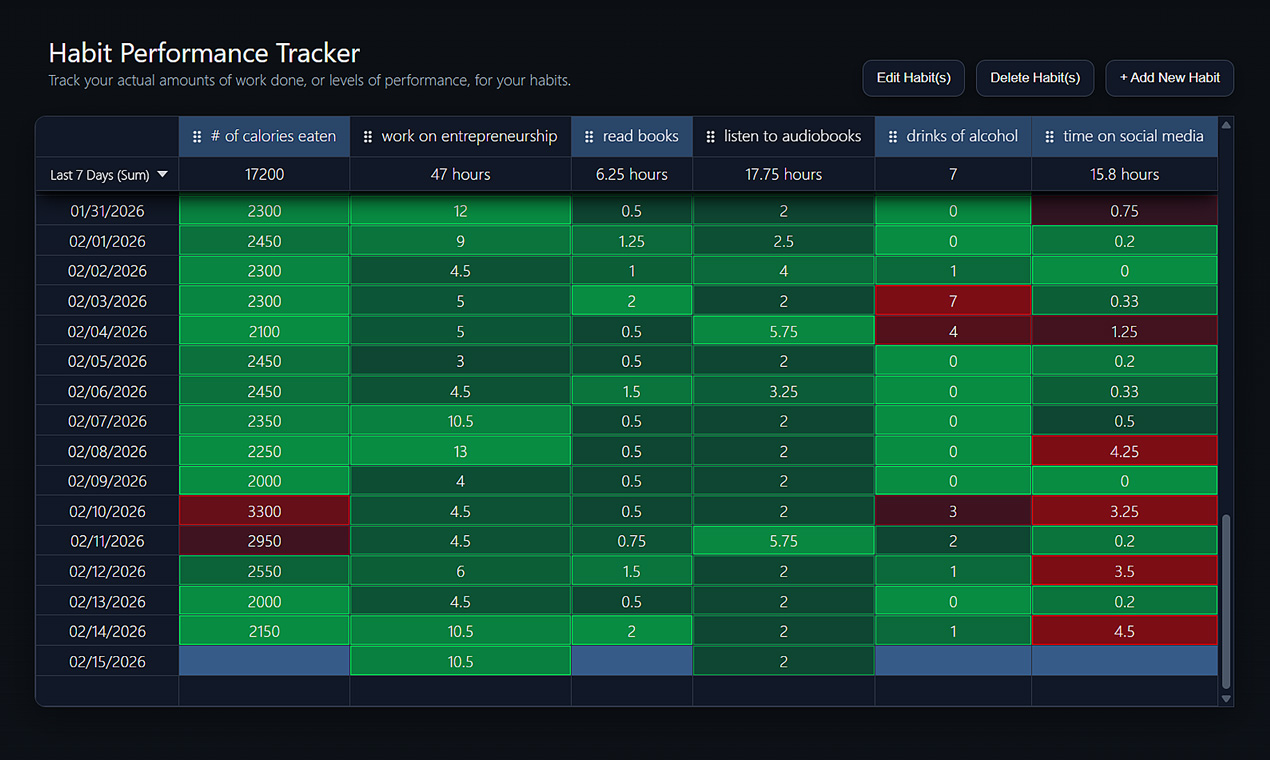
In terms of how to keep track of your habit streaks, some like Jerry Seinfeld recommend using a simple Red X marked on sequential days of a pin-up calendar. This is nice for tracking one singular habit, but if you're trying to build and track several positive habits (as you should be), you'd almost certainly be better off either using an Excel spreadsheet or a habit tracking tool to keep track of all your different streaks. I personally use the Super Simple Habit Tracker for these purposes, and that's probably no coincidence because I built that website myself to function as the perfectly-ideal habit-tracking tool for my own personal daily usage. I use it to track my streaks, and I also use it to track the actual amounts of work I'm doing in each area as well. It's not just a boring tracker, but it's actually pretty fun and satisfying to use.
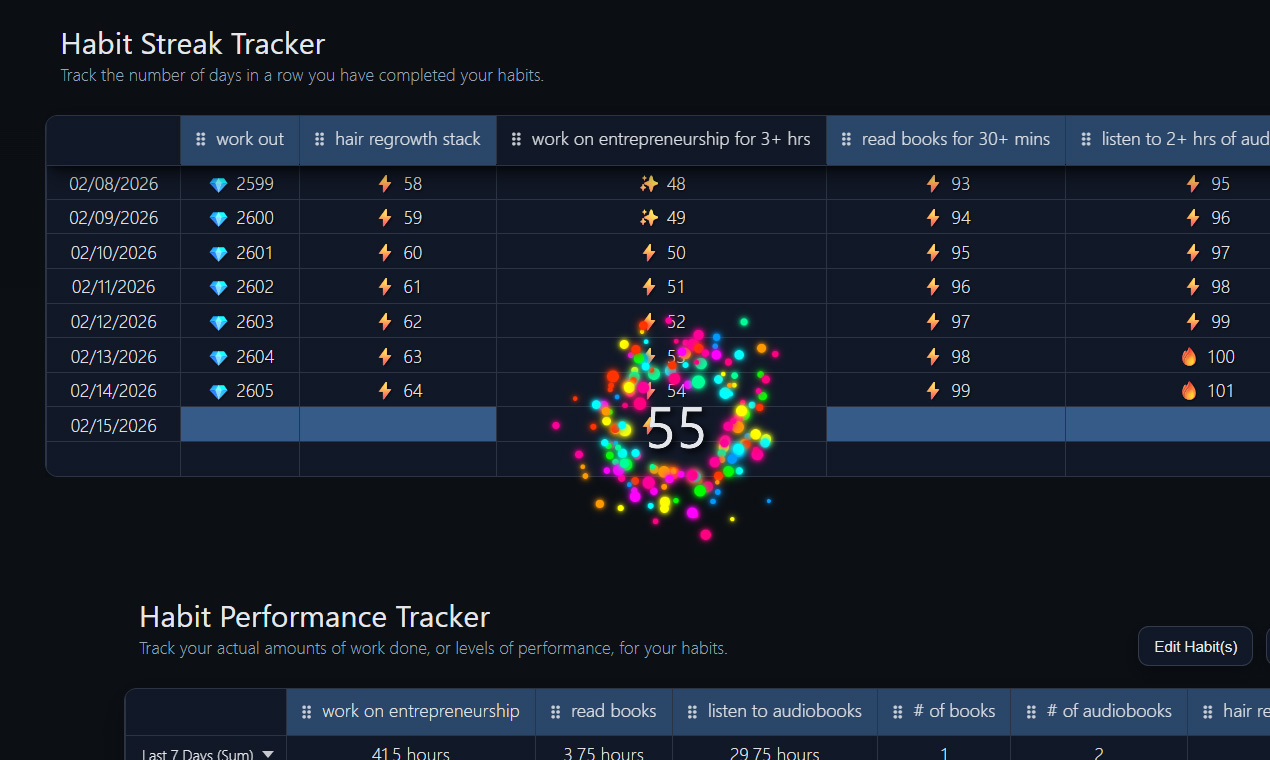
Anyway, there are many such habit-tracking tools out there, so no need to use my own if you think it's dog shit, but the bottom line is, if you are SERIOUS about building new habits and sticking with them consistently, keeping track of and building your streaks to increasingly larger numbers is one of THE most powerful ways to lock in a habit like nothing else can.
Good Advice #4: Develop a consistent ROUTINE that you stick to, which works with your schedule.
I've found this to be particularly helpful for locking in new habits. I've also found that when I try to execute on my habits WITHOUT having a rigid daily routine — instead allowing my day to just become a herky-jerky mish-mash of feelings-guided chaos — I can still technically get the habits done that way, but things definitely FEEL a lot smoother when there's a clear, machine-like routine that you execute on.
Some examples follow of how I actually utilize this in my own personal life for some of my major habits:
Desired Habit == "Read books for 30+ minutes per day"
Consistent Routine == "Read books while eating for the full duration of my 30-minute lunch break at work"
Desired Habit == "Listen to 2+ hrs of audiobooks per day"
Consistent Routine == "Listen to audiobooks (on 2.75x speed) while getting ready for work in the morning, AND while commuting to and from work."
There's a time, there's a place, you know what you're going to do and when/where you're going to do it. You may not win any awards for spontaneity if you live your life this way, but god damn will you become consistent!
Beyond just showcasing what a habit-routine can look like, you'll also notice there's a BONUS POWER TIP inside of those above examples, where another very effective productivity-improving / time-management strategy is being utilized. See if you're clever enough to spot what it is before I explain it...
What those above examples also illustrate is the value of COMBINING two different actions, instead of doing each separately in sequence: You're going to have a 30-minute lunch break anyway, so you'd might as well read a book while you're doing so; You're going to be getting ready for work and commuting anyway, so you'd might as well listen to some educational audio while you're doing it. I like to refer to this strategy as "task consolidation" (as opposed to multi-tasking, which tends to have a more "scatterbrained stupid fuck" connotation to it), and where I see opportunities, I try to execute on some of my habits in this way. This strategy is huge because it effectively allows you to complete some of your key daily habits without spending any additional time on them. The "I don't have enough time" excuse therefore gets eliminated, and you also just have more time in the day to spend on other valuable activities.
All you need to do, to consolidate your tasks like this and fit some of your key habits in this way, is just to ask: "What are the main habits I want to complete each day, and are there any opportunities to get them done while doing other things that I would already be doing anyway?" You'd be surprised at how many such opportunities present themselves if only you take the time to think it through for a few minutes.
Good Advice #5: Do NOT depend upon "feeling like doing it"; instead, utilize sheer willpower to FORCE yourself to do it.
This is probably the one piece of advice that people hate most when they hear it (probably because they're secretly looking for some magical habit-creation hack that eliminates the need to do boring, difficult work.) This is also the one single piece of advice that I most strongly believe in, probably more than any other one that I could give you. In fact, I would go so far as to say if there is ONE single skill that a person could develop, that would almost GUARANTEE their ability to achieve any goal they could set for themselves, it would be this simple willingness to FORCE THEMSELVES to do things that are good for them, regardless of whether they feel like doing them or not. Master that ability, and the world is yours.
So much of conventional habit-building advice centers around things like trying to make the required work easier, setting the bar incredibly low so that at least you're taking SOME pathetic action, tossing your goals in the toilet and replacing them with more "realistic" targets, or otherwise trying to find clever tricks to make things that are good for you not feel like the hard work that it is.
I think this is the exactly incorrect way to think about habit-formation and productivity, and I take a much more uncompromising stance on this: I would argue that your desired habits are not the problem; YOU and your pathetically weak mind are the problem. Your habits don't need to become easier using clever tactics or shameful compromises; YOU need to become better at disciplining yourself to do the the hard, boring things that will help you to achieve your goals. Get this through your head: There is no escaping the work. You have to do the work, you have to do a lot of it, and you have to do the work when you don't feel like doing it.
Yes, this doesn't mean that you should DELIBERATELY make things harder on yourself like some moron; by all means, if there IS a way to achieve the same outcome in a way that feels like less of a boring slog, go for it. However, after doing years of committed self-improvement work, after reading hundreds of books in this area, and after trying just about every conceivable system and productivity technique you could imagine, I eventually came to the realization that many of the key things that will help me to most rapidly achieve my goals will almost always just be a brutally difficult grind — especially if you're particularly aggressive with the amount of action you want to be taking in these areas.
Sure, if you just sit down at the computer every now and then and do a little bit of work on a side hustle only when you feel like doing it, ok THEN maybe you really will enjoy every moment; but if you're really pushing yourself flat out to pursue your goals, and if you're truly approaching anything near the maximum level of effort you can put in for a consistent period of time, there's just no conceivable way that it's always going to feel fun and easy to push yourself this consistently on these activities for so many hours of so many consecutive days. This realization might sound pretty grim and demoralizing, but I would argue that it's actually quite liberating: Because once you FINALLY realize that it's probably always going to be difficult, then you know what you're up against, then you can stop fooling yourself with a bunch of fake happy-talk that you know deep-down is bullshit, and then you're in a much better position to actually structure a gameplan that will allow you to complete your habits each day.
I also consider this to be one of the major paradoxes of self-improvement: Expecting that it's going to suck actually makes things much, much easier. And that's because there's no more confused wrestling with yourself, there's no more trying to get yourself pumped up to do it, there's no more waiting around until you "feel" like doing it; there's simply a task that needs to be done, and a person who can sit the fuck down and do it (ie, you.)
If you can only just develop this one single ability — of forcing yourself to do gigantic piles of effective work specifically when it is the LAST thing on the planet that you feel like doing — you are well on your way to quickly becoming an absolutely unstoppable goal-achieving juggernaut.